
How to Treat Curry and Coconut Oil Stains on Clothes
In this guide
A curry splash can contain coconut oil or another fat, turmeric and chilli pigments, tomato, dairy, protein, starch, and ground spices. Treating only the yellow colour may leave a dark oily ring; treating only the grease may leave pigment. Work in layers and keep the garment away from dryers and irons until every component is gone.

Quick answer
Gently scrape off food, blot oil with a clean white cloth, and check the care label. For a sturdy colourfast washable item, rinse from the back with cool or lukewarm water, apply liquid laundry detergent or a fabric-safe grease stain remover, and allow the labelled contact time. Wash at the warmest care-label temperature, then air-dry and inspect. Treat remaining colour with an oxygen-based product only when both labels permit.
Kunam Loundry service
No 31 lotus park road, aless garden, Trincomalee, Sri Lanka
Understand the layers in a curry stain
Coconut milk, coconut oil, ghee, butter, cooking oil, meat fat, and fried ingredients create a grease stain that spreads beyond the visible centre. Turmeric contributes curcumin, a strong yellow-orange pigment. Chilli, paprika, tomato, tamarind, leafy ingredients, and browned spices add other colours.
Protein from dairy, egg, fish, or meat and starch from rice or flour can dry into the fabric. A restaurant curry recipe may contain several of these at once.
Tell a laundry service the dish and likely ingredients, not simply “yellow stain.” Mention coconut oil, turmeric, dairy, or seafood when known, along with any treatment already applied.
Lift solids and blot oil
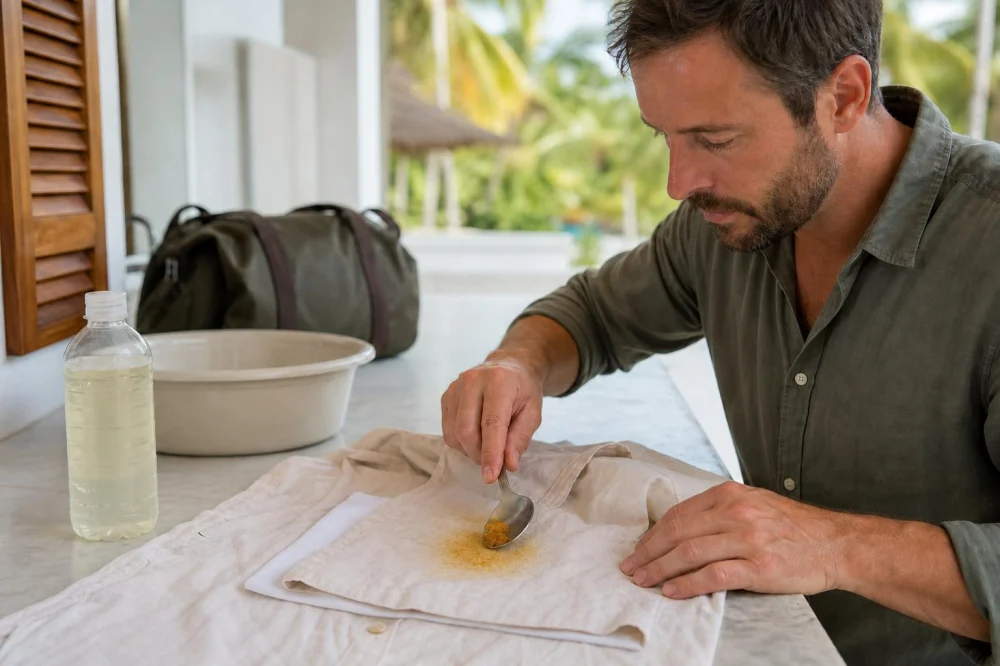
Use the edge of a spoon or dull utensil to lift food without pushing it across the fabric. Work from the outside toward the centre. Do not rub with a napkin; friction spreads oil and drives pigment deeper.
Blot both sides with clean white absorbent material. Replace the blotting surface as it becomes oily. For a washable sturdy fabric, a small amount of plain absorbent powder may be used only if a suitable laundry product directs it; brush it off completely before wet treatment.
Do not grind salt, flour, chalk, toothpaste, or random powder into a valuable garment. Home materials can add dyes, abrasives, fragrance, or residue.
Pretreat the oily component
Place a clean white towel behind the stain. Apply liquid laundry detergent or a labelled grease stain remover to a colourfast washable fabric. Gently spread it with fingers or a soft cloth from the outer edge inward.
A small amount of clear hand dishwashing liquid can cut food grease on some sturdy washable garments, but it is not formulated for every textile or washing machine. Test first, rinse it out thoroughly by hand, and never pour it into an automatic washer where excess foam can cause problems.
Follow contact-time and dilution directions. Do not let a pretreatment dry unless the label explicitly permits it. Enzyme products may help food components but can be unsuitable for wool, silk, or certain finishes.
Treat turmeric and coloured spices
After the grease treatment and rinse, assess the yellow, orange, or red colour under good light. For colourfast washable fabric, an oxygen-based bleach or stain remover may reduce residual pigment when approved by the garment and product labels.
Test on a hidden seam first. Mix the correct concentration and limit the soak to the stated time. More product and longer soaking can damage dye, elastane, prints, embroidery, and fibres.
Sunlight can fade turmeric, but it can also fade the garment unevenly, weaken some fibres, and heat-set remaining oil or protein. Treating sun as a precise stain remover is unreliable; use controlled labelled methods instead.
Wash and inspect before heat
Wash with compatible colours at the warmest temperature allowed by the garment care label. Use the normal detergent dose and a cycle suited to the fabric. Overloading reduces movement and rinsing around the stain.
Inspect while damp for a dark translucent ring, yellow cast, red edge, stickiness, or odour. View both sides and compare under daylight if possible.
Air-dry until the result is confirmed. A tumble dryer or hot iron can make residual oil, protein, and pigment harder to remove. If a mark remains, repeat the appropriate step before heat.
Repeat gently for a dried stain
Place the stained area over a clean towel, apply a fabric-safe grease pretreatment, and allow time to loosen the oil. Rinse from the back, then reassess the pigment. Old stains often need several controlled cycles.
Do not respond by escalating immediately to concentrated bleach or hard scrubbing. Fibre damage and dye loss can become more visible than the original stain and may be permanent.
If the garment has already been tumble-dried, tell the cleaner. Heat history changes the likely outcome, but professional treatment may still improve it.
Protect delicate and colour-unstable garments
Silk, wool, viscose, acetate, leather, suede, embellished fabric, traditional dress, tailored clothing, and dry-clean-only items need specialised assessment. Water, enzymes, alkalinity, bleach, and rubbing can cause rings, shrinkage, texture change, bleeding, or loss of finish.
Blot without spreading, do not experiment with kitchen chemicals, and take the item to a professional cleaner promptly. Keep the stained area exposed to air rather than folding it against clean fabric.
Point to every spot and state the ingredients. A transparent oil halo may extend farther than the yellow centre, so adequate inspection matters.
Control the stain while travelling
At a restaurant, lift solids and blot. If the garment is clearly washable and safe to wet, use a cool-water back-rinse at the accommodation. Do not rub with a coloured towel or use a hotel hair dryer.
After rinsing, press moisture out with a clean white towel and hang with airflow. Do not seal a damp oily garment inside luggage. Use a separate breathable or temporary waterproof bag only for transport to laundry, then remove it promptly.
For drop-off service, photograph the item, empty pockets, identify the stain, and confirm the treatment and return time. Allow enough time for complete cleaning and drying before departure.
Products and methods to avoid
- Do not tumble-dry or iron a remaining curry mark.
- Do not rub turmeric with a coloured cloth.
- Do not apply chlorine bleach to colour, wool, silk, elastane, or unknown fabric.
- Never mix chlorine bleach with acids, vinegar, ammonia, alcohol, or other cleaners.
- Do not combine several stain removers without rinsing and checking compatibility.
- Do not pour dishwashing liquid into a washing machine.
- Do not use solvent near flame or without the product's required ventilation.
Frequently asked questions
Why does a yellow stain remain after the grease is gone?
Turmeric and other plant pigments can remain after oil is removed. A fabric-safe oxygen treatment may help on colourfast washable items.
Does coconut oil wash out with water?
Not well by itself. Oil repels water and usually needs detergent surfactants plus washing at a fabric-safe temperature.
Can I use lemon juice on turmeric?
Acid can change dye or finish and is not predictable across fabrics. Prefer a labelled laundry product and never mix acid with chlorine bleach.
Will sunlight remove a curry stain?
It may fade some pigment but can also fade the garment and leave oil behind. Controlled treatment is safer.
Can a professional cleaner remove an old curry stain?
Possibly, but fibre, dye, ingredients, age, prior products, and heat affect the outcome. Complete information improves the assessment.
Remove oil, pigment, and heat in that order
A curry stain is a combination, not a single colour. Lift the food, blot the oil, pretreat grease with a fabric-safe product, wash by the care label, then address remaining spice pigment. Keep heat away until the stain is fully gone. For delicate, valuable, unstable, or dry-clean-only clothing, prompt professional service protects the garment better than aggressive improvisation.





 Laundry service nilaveli4.0 (2 reviews)
 Quick & clean laundry2.0 (5 reviews)
 LOTUS LAUNDRY CHEMICALS5.0 (1 reviews)
 Laundry service3.0 (3 reviews)
 Moris Laundry0.0 (0 reviews)
 Red Rose Washing Hub🌹5.0 (4 reviews)
 How to Wash Curtains Without Shrinking or Wrinkling Them
 How to Get Mustard Stains Out of Clothes at Home
 How to Wash Towels Without Leaving Lint
 How to Wash Silk Blouses Without Stretching the Fabric
 What Should You Do When Clothes Smell Like Sweat After Washing: Effective Solutions
 How to Wash Denim Without Losing Color or Fit