
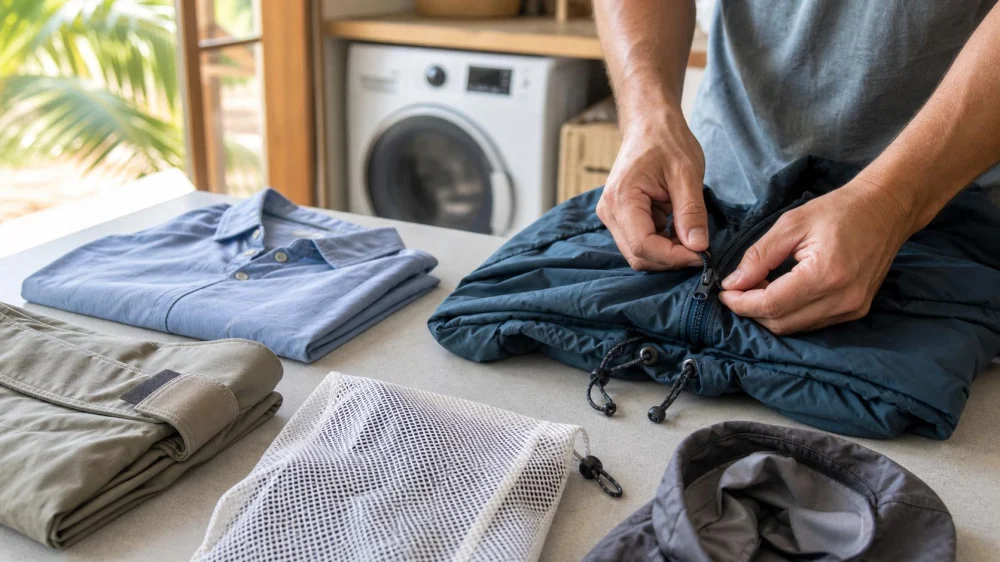
Before the Wash: Secure Zips, Fasteners and Drawstrings
On this page
- Quick answer
- Why fastener preparation matters
- Start with pockets and loose items
- Fastener-by-fastener guide
- When to use a mesh laundry bag
- Checklist for a laundry-service handover
- Checks after washing
- Limitations and important notes
- Sources and evidence notes
- Frequently asked questions
- Conclusion and next steps
Quick answer
Before washing travel clothes, empty every pocket, remove detachable accessories, fasten hook-and-loop tabs so they cannot catch other fabric, and secure long drawstrings. Zip and button handling depends on the garment, so follow its care label and manufacturer guidance. Put small or snag-prone items in a suitable mesh bag and tell the laundry service about any damaged fastener.
Laundry preparation is the inspection and securing of a garment before washing so loose objects, rough fasteners and long cords are less likely to damage the item, the machine or another garment. It does not repair a weak zip or torn seam; damaged clothing should be assessed before it enters a load.

Why fastener preparation matters
Travel clothing often combines zips, press studs, buckles, hook-and-loop tabs, elastic toggles and removable padding. During washing, an exposed rough edge can catch a knit, a long cord can wrap around other clothes, and a loose object can strike the drum or block a pump.
Preparation is useful for hiking trousers, convertible garments, swimwear, lightweight jackets and bags designed to be washed. However, the correct position of a zip or button can vary by construction. The care label and brand's instructions should take priority over a universal rule.
Sigiri Super Clean Laundry (Pvt) Ltd
SigiriyaMataleCentral Province
No 207/C, Sigiriya 21120, Sri Lanka
Start with pockets and loose items
- Turn every pocket out where the garment allows and remove its contents.
- Check small security pockets, coin pockets, sleeve pockets and hidden passport compartments.
- Brush out sand, seeds and dry debris outdoors where appropriate.
- Remove detachable belts, pins, badges, key clips, foam inserts and other accessories when instructed.
- Inspect pocket linings for holes that could trap small objects inside the garment.
- Return pockets to the position recommended for washing.
Paper tissues can break apart through a load; coins and keys can damage fabric or equipment; lip balm and pens can create stains. Never wash batteries, electronics, medication, matches or lighters.
Fastener-by-fastener guide
Zips: Check for missing teeth, separated coils, a loose slider or fabric caught in the track. Follow the garment instruction on whether to close it. Do not force a jammed zip or rely on washing to free it.
Hook-and-loop fasteners: Close matching tabs so the hook surface is covered. Remove lint already trapped in the hooks using a method safe for the material. Keep them away from delicate knits.
Buttons and press studs: Inspect loose stitching and sharp edges. The appropriate open or closed position depends on garment stress and construction, so use specific care guidance. Repair a nearly detached button before washing.
Drawstrings and cords: Shorten or secure long ends using the garment's own system without tying a knot that could tighten permanently. Check that cord locks are intact and cannot escape into the machine.
Buckles and hooks: Remove detachable pieces when instructed. Cover or contain hardware that could strike the machine or snag fabric, using a laundry method approved for the garment.
When to use a mesh laundry bag
A washable mesh bag can keep small items together and reduce contact between snag-prone hardware and the rest of the load. It is useful only when the bag size, closure and wash method suit the items.
- Do not overfill the bag; clothing still needs room to move and rinse.
- Close the bag fully and inspect it for broken mesh or a sharp zip pull.
- Separate heavy hardware from lightweight delicate fabric.
- Do not assume a bag makes a non-machine-washable item safe for a machine.
- Keep different care temperatures and colours separated as required.
A pillowcase is not automatically an equivalent because its fabric, closure and effect on washing may differ. Use a purpose-made bag or follow reliable garment guidance.
Checklist for a laundry-service handover
When using a service in Sigiriya or elsewhere in Sri Lanka, inspect and prepare the clothes before arrival when possible. Then confirm:
- Staff know about a weak zip, loose button, torn pocket or detachable part.
- Special-care garments are separated from the standard load.
- Accessories removed from clothing are kept by you.
- The agreed wash and drying methods match the care label.
- Small items in mesh bags are counted and documented.
- No repair or stain treatment will be added without approval.
A laundry service cannot identify every hidden weakness. Pointing out existing damage protects the garment and helps the provider decide whether it can accept the item.
Checks after washing
Before drying, inspect fasteners if the process allows. Heat and tumbling can worsen a part that was damaged during washing. At collection, move each zip gently, confirm drawstrings remain in their channels and check button stitching, tabs and removable parts.
Do not pull harder on a stuck slider. Let the garment dry as directed and seek repair if the fabric is caught, the track has separated or a tooth is damaged. Keep small broken hardware away from children and pets.
Limitations and important notes
This is general garment-care guidance. Clothing and equipment designs vary, and a rule appropriate for one zip or buckle may damage another.
- Always follow the permanent care label and manufacturer instructions.
- Do not machine-wash bags, footwear, waterproof garments or protective equipment unless their instructions allow it.
- Items contaminated by chemicals, fuel or hazardous material need specialised advice, not a routine load.
- Unplug and remove all electronic modules from smart clothing according to official instructions.
Sources and evidence notes
The guide applies broad textile-care principles: remove foreign objects, reduce snag points, contain suitable small items, avoid mixing incompatible weights and follow construction-specific instructions. Exact fastener positions, wash cycles and drying methods must come from the garment label, manufacturer or qualified cleaner.
Frequently asked questions
Should every zip be closed before washing?
Not as a universal rule. Garment construction and instructions differ. Inspect the zip and follow the care label or manufacturer guidance for that item.
How do I wash clothing with hook-and-loop tabs?
Close matching surfaces so exposed hooks are covered, then follow the garment's wash instructions. Keep rough tabs away from delicate fabrics and repair damaged stitching first.
Can I tie drawstrings in a knot?
A tight knot can become difficult to remove or distort the cord. Use the garment's intended cord lock or a gentle securing method recommended by its maker.
Will a mesh bag protect a broken fastener?
It may contain a suitable item, but it does not repair damage. A sharp or loose fastener can still harm its own garment. Repair or seek advice before washing.
What should I tell a laundry service?
Identify weak seams, damaged fasteners, special-care labels and any removable parts. Confirm that the provider accepts the item and understands the required method.
Conclusion and next steps
A two-minute fastener check can prevent avoidable trouble in a travel laundry load. Empty every pocket, remove loose accessories, cover rough tabs, secure cords and isolate suitable small items. When a part is damaged or the instructions are unclear, keep the garment out of the standard wash until you have reliable care guidance.



 Super Clean Laundry4.0 (25 reviews)
 TJ Laundry4.0 (5 reviews)
 Fresh and Clean Laundry4.0 (29 reviews)
 Home stay laundry4.0 (10 reviews)
 Srimal electrical5.0 (1 reviews)
 Senkadagala Washing Plant (pvt)Ltd.4.0 (12 reviews)
 How to Effectively Remove Coffee Stains from Wool Sweaters
 Why Clothes Feel Sticky After Washing and How to Fix It
 Clothes Not Clean? Common Laundry Problems and Fixes
 How to Remove Mold Smell from Clothes Easily
 Common Laundry Problems and How to Solve Them Efficiently
 Laundry Item Missing or Damaged in Sigiriya? Document It Before Checkout