
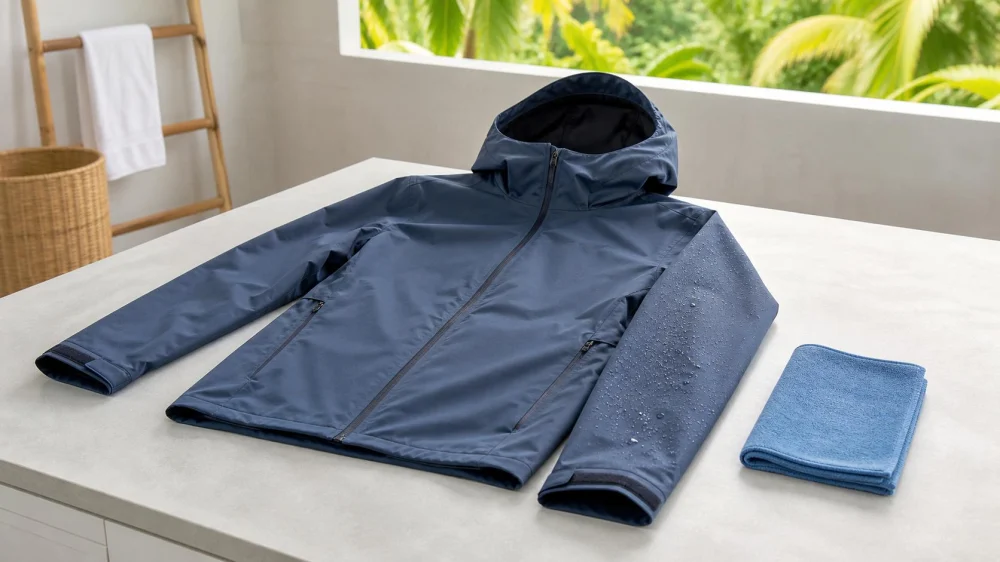
Rain Jacket Laundry in Sigiriya: Protect the Membrane and Finish
On this page
- Quick answer
- Identify the exact jacket system
- Prepare pockets, zips, and closures
- Ask the laundry precise questions
- Control detergent and wash cycle
- Rinse away all residue
- Use only label-approved drying
- Understand DWR and wetting out
- Inspect before packing
- Rain-jacket laundry checklist
- Important limitations
- Evidence notes
- FAQ
- Next steps
Quick answer
Before sending a waterproof or waterproof-breathable jacket to a Sigiriya laundry, read the garment's care label and the exact manufacturer's instructions. Empty pockets, close zips, secure hook-and-loop tabs, and tell the service the permitted detergent, cycle, rinse and drying method. Decline fabric softener, bleach, dryer sheets, aggressive stain remover and unapproved heat.
Do not ask a laundry to “waterproof” the jacket with a generic product. Cleaning, heat activation and adding a new durable water-repellent treatment are separate steps, and each must be allowed by the specific garment maker.

Identify the exact jacket system
Record the brand, model, membrane or coating, shell layer construction, insulation, lining, seam tape, waterproof zips and care symbols. Not every rain jacket uses the same fabric technology, and a waxed garment or poncho can require a different method from a laminated breathable shell.
Photograph the label and existing wear. Check for peeling seam tape, delamination, damaged cuffs, torn mesh, loose zip sliders and flaking inner coatings before washing.

Prepare pockets, zips, and closures
Remove every item, including tissues, receipts, lip balm, batteries, sunscreen and insect repellent. Brush off dry mud gently. Close the main zip, pocket zips and ventilation zips when the maker directs; fasten hook-and-loop cuffs and loosen drawcords so hardware cannot abrade the fabric.
Remove detachable accessories only when the instructions allow it. Do not pin a paper ticket through the shell or write directly on the garment.
Ask the laundry precise questions
- Has the service cleaned this exact fabric or model before?
- Will the machine be free of softener and powder residue?
- Which liquid or technical wash will be used?
- What water temperature and cycle match the label?
- Can an extra rinse be provided?
- How will the jacket be dried in humid weather?
- Will any DWR treatment be added without separate approval?
If the service cannot isolate the jacket from ordinary additives or follow the label, hand washing or a specialist service may be safer.
Control detergent and wash cycle
Use only the small amount and product type specified by the garment maker. Waterproof-breathable fabrics often require a mild liquid or dedicated technical wash that rinses clean. Ordinary powder, softener, bleach and stain-treatment additives can leave residue or damage performance.
Choose the permitted machine type and gentle setting. Clean the detergent drawer when needed to prevent carryover. Do not crowd the jacket with rough, oily or heavily dyed garments.
Rinse away all residue
Detergent residue can affect surface wetting, breathability and skin comfort. Manufacturer guidance for many technical shells calls for thorough rinsing, sometimes a second rinse. Confirm the machine completes it.
If suds or fragrance remain, do not mask them with another product. Ask the service to repeat the approved rinse process.
Use only label-approved drying
Some shell makers use label-approved low or warm tumble drying to reactivate the existing DWR; other garments require line drying or different limits. Follow the jacket label, not a universal time or temperature. High heat can damage membranes, seam tape, coatings, elastic and plastic parts.
In Sigiriya's humid climate, shaded air drying may take longer. Keep the jacket ventilated until seams, pockets, cuffs and lining are fully dry before packing.
Understand DWR and wetting out
DWR is the finish that helps water bead and roll off the outer face fabric. Dirt, body oils and abrasion can weaken that beading. When the face fabric wets out, the underlying waterproof barrier may still resist rain, but the jacket can feel heavier and less breathable.
First wash and dry the jacket exactly as directed. If beading does not recover, ask the manufacturer whether to use a spray-on or wash-in treatment, which product suits the garment, and where it should be applied. More product is not automatically better.
Inspect before packing
- Compare the jacket with the pre-wash photos.
- Check colour, printed details, zips, tabs and drawcords.
- Look for new peeling, bubbles or seam-tape lifting.
- Smell for detergent or dampness.
- Confirm every pocket and lining is dry.
- Test water beading only as the maker recommends.
- Report a problem before leaving when practical.
Rain-jacket laundry checklist
- Exact label and maker instructions saved.
- Pockets empty; zips and tabs prepared correctly.
- Existing damage photographed.
- Approved detergent, machine and cycle confirmed.
- Softener, bleach, powder residue and dryer sheets excluded.
- Extra rinse and label-approved drying agreed.
- DWR treatment requires separate approval.
Important limitations
This is general traveller guidance, not a substitute for garment instructions, warranty terms or specialist textile advice. Rainwear technologies, coatings, insulation, damage and laundry equipment vary. A service may reasonably decline a jacket it cannot process safely.
Evidence notes
Current REI rainwear guidance puts manufacturer directions first, recommends technical cleaners and thorough rinsing, and warns against softener and dryer sheets. Current Patagonia guidance supports mild technical detergent and low heat for its waterproof shells, while GORE‑TEX care information similarly makes the sewn-in label controlling. Those examples reinforce model-specific handling.
FAQ
Can I wash a rain jacket with regular clothes?
Only if its label permits it and the load, detergent and machine are compatible.
Is fabric softener safe for waterproof fabric?
Generally avoid it for waterproof-breathable shells unless the maker explicitly says otherwise.
Should the jacket be tumble dried?
Follow the care label; permitted heat can help some DWR finishes but damage other garments.
Does wetting out mean the membrane leaks?
Not necessarily. The outer fabric can saturate while the underlying barrier still functions.
Can a laundry add waterproofing spray?
Only after you verify the maker-approved product and application method.
Why use an extra rinse?
It can remove cleaner residue that affects performance and comfort.
Next steps
Photograph the jacket and label, open the maker's current care page, and show both to the Sigiriya laundry. Agree on detergent, cycle, extra rinse and drying before handoff, and authorise DWR treatment only as a separate verified step.






 Wash Master4.0 (69 reviews)
 Laundry service3.0 (3 reviews)
 TJ Laundry4.0 (5 reviews)
 LOTUS LAUNDRY CHEMICALS5.0 (1 reviews)
 Kleen Laundry5.0 (74 reviews)
 RAPID Laundromat (Pvt) Ltd5.0 (73 reviews)
 Best Ideas for Washing Linen Pants Without Creases
 Clothes Smell Damp? Learn How to Fix It Easily
 How to Wash Baby Blankets Without Shrinking
 Your Laundry Might Be Missing Something: Tips for Cleaner, Fresher Clothes
 Swimsuit Laundry After Pool or Sea: Rinse, Wash, and Dry
 Best Hacks to Keep Towels Fluffy and Absorbent